

 0
0
 0
0
Cover Photo Provided by:Kirby Lee, Imagn Images
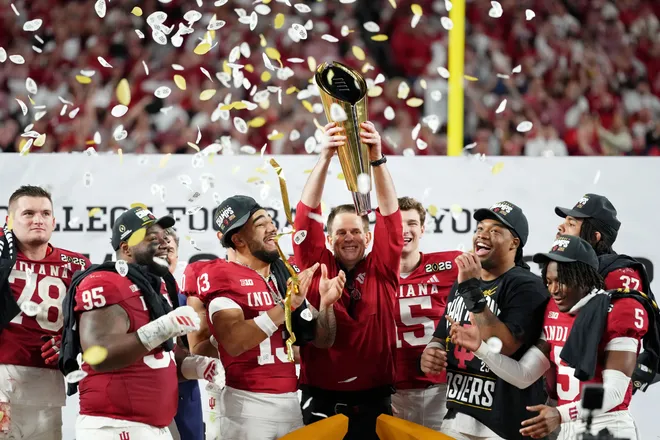
MIAMI GARDENS, Fla. — College football witnessed one of the most improbable championship moments in the history of the sport on Monday night, as the Indiana Hoosiers completed an undefeated season and captured their first national title with a 27–21 victory over the Miami Hurricanes in the College Football Playoff National Championship Game.
The defining moment came late in the fourth quarter and will live forever in Indiana lore.
Facing fourth-and-4 from the 12-yard line, Heisman Trophy winner Fernando Mendoza lowered his shoulder into a defender, spun through contact, steadied himself with one hand, and launched his body across the goal line for a breathtaking 12-yard touchdown run. The play extended Indiana’s lead, sealed the outcome, and instantly became one of the most iconic images in championship history.
If this season ever becomes a movie, there may be no better title than Hoosiers.
Indiana’s victory capped a flawless 16–0 campaign and delivered a national championship to a program that, for nearly 140 years, had been defined by struggle and obscurity. Under head coach Curt Cignetti, that narrative has been completely rewritten.
“Let me tell you something,” Cignetti said after the game. “We won the national championship at Indiana University. It can be done.”
When Cignetti took over just two years ago, Indiana owned more losses than any program in college football history. In two seasons, he transformed the Hoosiers into the sport’s ultimate standard-bearer.
Mendoza finished the night with 186 passing yards, but it was his toughness and fearlessness as a runner that defined the championship. Despite being sacked three times and battered throughout the game by Miami’s aggressive defense, Mendoza delivered when Indiana needed him most.
“I would die for my team,” Mendoza said afterward. “It was fourth down. You’ve got to put everything on the line.”
That touchdown gave Indiana a 24–14 lead, though Miami refused to go quietly. The Hurricanes mounted a furious comeback behind the powerful running of Mark Fletcher, who rushed for 112 yards and two touchdowns, cutting the deficit to one score late in the game.
Miami proved it belonged on the championship stage, battling to the final possession in front of a home crowd at Hard Rock Stadium. The Hurricanes even drove into Indiana territory in the closing moments, but a last-ditch pass was intercepted by Jamari Sharpe, a Miami native who ensured the only miracle of the night belonged to Indiana.
Indiana’s championship run was marked by bold decision-making, none bigger than two fourth-down gambles in the fourth quarter. One resulted in a critical 19-yard completion to Charlie Becker. The other was the now-legendary quarterback draw that produced Mendoza’s airborne touchdown.
“We rolled the dice,” Cignetti said. “We trusted our guys, and they delivered.”
The significance of this title extends far beyond one game. Indiana finished with a perfect record, matching a feat last achieved in major college football in 1894. The championship also arrives exactly 50 years after Bob Knight’s undefeated 1976 basketball team, tying two of the greatest seasons in Indiana athletic history together across generations.
Bloomington, long known as a basketball capital, is now home to a college football national champion.
The celebrations began immediately and will not end anytime soon. Alumni, students, and fans flooded the streets as crimson and cream confetti symbolized a program reborn. A new banner will rise. A new identity is now permanent.
From decades of half-empty stadiums and historic losing streaks to the pinnacle of the sport, Indiana football has completed one of the greatest turnarounds college athletics has ever seen.
“I know nobody thought it was possible,” Cignetti said. “It probably is one of the greatest sports stories of all time.”
The Hoosiers are no longer chasing history.
They are the history.
Indiana football is national champion.


